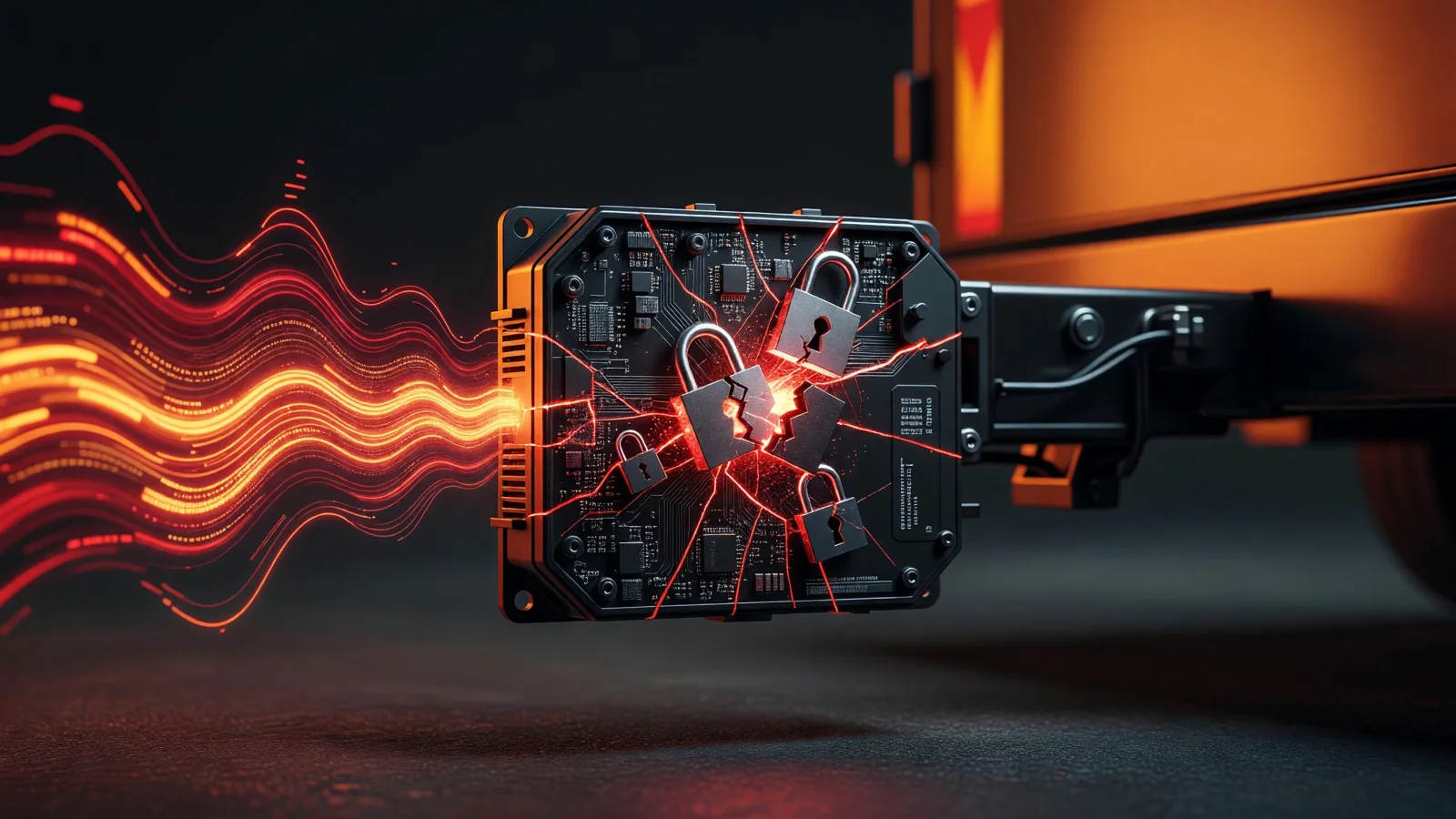
Multiple security vulnerabilities discovered in popular electronic trailer brake controllers could allow nearby attackers to wirelessly manipulate braking behavior, alter firmware, and disable vital safety functions. The issues affect hardware developed by Australian manufacturer Elecbrakes, widely utilized across Australia and New Zealand's transportation sector.
The Cybersecurity and Infrastructure Security Agency released an advisory detailing the flaws on November 19, 2026. According to the CISA advisory, researchers Patrick Forck and Jeremy McCarthy from Element Digital discovered and reported the weaknesses, which carry maximum CVSS v3.1 base scores of 9.6.
Flaws Allow Unauthenticated Bluetooth Control
The most severe vulnerability, tracked as CVE-2026-96805, stems from missing authentication for critical functions (CWE-306). The flaw allows any in-range Bluetooth Low Energy (BLE) device to access and write to the controller interface. An attacker does not need prior pairing or authentication credentials to manipulate vehicle braking parameters while within wireless transmission range.
Compounding this issue is CVE-2026-125273, an authentication bypass vulnerability caused by capture-replay weaknesses (CWE-294). The device does not implement command-integrity protection or replay defense mechanisms such as session tokens, nonces, or sequence numbers. Consequently, captured wireless commands can be retransmitted to the device, and previously issued commands persist across different sessions.
A third flaw, designated CVE-2026-124281, involves an exposed dangerous method or function (CWE-749) scored at CVSS 6.1. The controller uses an unprotected firmware-update channel, opening the door for unauthorized entities to flash modified, malicious firmware directly onto the device.
If chained or exploited independently, the vulnerabilities grant an adversary complete control over trailer braking. Potential consequences include unexpected brake engagement or disengagement, altered braking responsiveness, the disabling of trailer brake lights, and the neutralization of essential road safety mechanisms.
Affected Products and Remediation Status
The vulnerabilities impact three product lines manufactured by the Australia-based company:
- EB2: Versions 3.0.4.2.0 and earlier
- VM1: Versions prior to 1.3.4.2.1
- ELBC2000: All versions
Elecbrakes has released firmware updates to mitigate the issues for its newer product lines. Users operating the EB2 must update their devices to firmware version 3.0.4.4.3. Those running the VM1 controller must apply firmware update 1.3.4.2.1. Both updates can be applied directly by connecting the controller to the official Elecbrakes mobile application.
No patch is currently available for the older ELBC2000 model. The device represents a predecessor to the EB2 and VM1 hardware lines and is no longer actively sold. According to CISA, Elecbrakes is still determining how to address the vulnerabilities on the discontinued controller.
Risk Assessment and Threat Landscape
Because the attack vector is restricted to adjacent wireless range (AV:A), remote exploitation across the public internet is not possible. However, the lack of pairing requirements significantly lowers the barrier for local adversaries. An attacker operating in proximity on a roadway, at a rest stop, or inside a parking facility could interact with vulnerable hardware using standard BLE-capable gear.
At the time of disclosure, authorities confirmed there is no evidence of active, in-the-wild exploitation targeting these flaws.
What You Should Do
Fleet operators, individual drivers, and transport organizations relying on Elecbrakes units should take immediate remediation steps:
- Update EB2 and VM1 Hardware: Open the official Elecbrakes mobile application while paired to your controller and verify that the firmware is updated to version 3.0.4.4.3 (for EB2) or 1.3.4.2.1 (for VM1).
- Evaluate ELBC2000 Devices: Organizations using the legacy ELBC2000 controller should conduct an immediate risk assessment. Because no security fix currently exists, consider replacing unsupported controllers with patched hardware alternatives.
- Monitor for Abnormal Controller Behavior: Drivers should stay alert for anomalous brake controller disconnects, unexpected changes in brake sensitivity, or unexplained trailer light failures.
- Follow Transportation Cybersecurity Hygiene: Transportation teams should report any signs of suspected wireless tampering or unauthorized device interactions to organizational security leads and relevant reporting bodies.