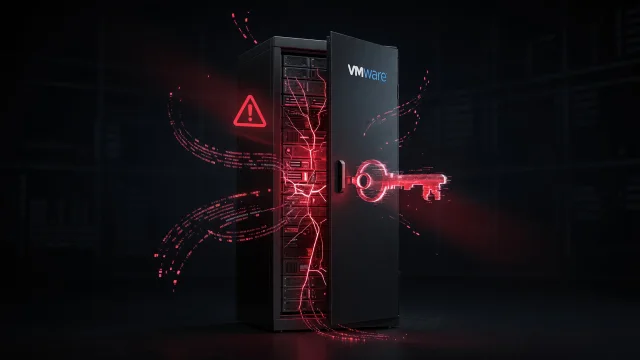
Broadcom has released emergency security updates to address a critical authentication bypass vulnerability in VMware vCenter Server. The flaw, tracked as CVE-2026-123890 with a CVSS score of 9.8, was actively weaponized in zero-day intrusions by a suspected Chinese state-sponsored espionage group for more than two months before a fix was made available.
According to security advisories published by the vendor, unauthenticated attackers with network access can bypass authentication mechanisms within the VMware Directory Service (vmdird). Successful exploitation grants remote administrative privileges over vCenter, effectively handing attackers full management control over all hosted virtual machines and ESXi hypervisors across an organization's infrastructure.
Chained Zero-Days Lead to Virtualization Takeover
Reporting from BleepingComputer indicates that Google's Mandiant and the Google Threat Intelligence Group (GTIG) linked the attacks to Armory Castle, an espionage cluster previously tracked as UNC5221. Mandiant confirmed investigating multiple intrusion incidents involving the flaw, which has been under active exploitation since at least early September.
The campaign demonstrated sophisticated lateral movement. Threat actors initially infiltrated victim environments by exploiting CVE-2026-102764, a separate zero-day vulnerability in BeyondTrust Remote Support appliances. After gaining initial access, the operators pivoted to internal Linux systems that lacked endpoint detection and response (EDR) software, where they deployed persistent "SLIMSAVAGE" web shells and escalated privileges to root.
From these unmonitored pivot points, the attackers scanned internal subnets for virtualization infrastructure and deployed a custom Go-based exploitation tool named BONESAW. The utility carries an internal build timestamp of July 13, suggesting the threat actor may have possessed exploit capabilities weeks before public disclosures of unrelated vCenter flaws.
Technical Mechanics of the Exploit
As detailed by Help Net Security, BONESAW interacts with the vCenter Server Directory Service RPC interface (vmdirdbcp) to establish an unauthorized administrative session under the [email protected] context. This access allows attackers to execute commands and siphon the directory database file, data.mdb.
Once the database was extracted, the threat actor utilized an additional tool dubbed SAWSNAKE to extract SAML signing keys. By obtaining these cryptographic keys, the attackers conducted Golden SAML attacks, forging authentication tokens that allowed them to bypass multifactor authentication and impersonate any legitimate user within the vSphere ecosystem.
During the documented intrusions, Armory Castle leveraged supplementary malware families, including backdoors and utilities designated as CAGEMATCH, BEARBONES, and LAZYBONES. With full administrative dominance over the hypervisor plane, the group accessed underlying ESXi hosts, extracted Windows Active Directory databases and registry hives directly from the storage disks of virtual machines, and staged the stolen data on the compromised edge appliances for final exfiltration.
Scope of Impacted VMware Products
Broadcom addressed the vulnerability on November 19 in security advisory VMSA-2026-0009. The update addresses CVE-2026-123890 alongside four other security flaws affecting VMware SDDC Manager and VMware Tools for Windows. While Broadcom's advisory did not explicitly detail the active exploitation, the company credited Mandiant with discovering the flaw and urged administrators to treat the update as an emergency priority.
The vulnerability affects organizations running vCenter Server and SDDC Manager prior to the resolved versions, whether installed as standalone deployments or integrated into VMware Cloud Foundation, VMware vSphere Foundation, VMware Telco Cloud Platform, and VMware Telco Cloud Infrastructure. Broadcom explicitly noted that systems remain vulnerable regardless of whether Enhanced Linked Mode is enabled or disabled.
What Defenders Should Do
Broadcom confirmed that no functional workarounds exist to neutralize CVE-2026-123890, meaning that software patching is mandatory. Defenders must take immediate action to isolate and protect virtualization assets:
- Apply official vendor updates: Immediately upgrade standalone and bundled instances of VMware vCenter Server and SDDC Manager to the fixed releases specified in VMSA-2026-0009.
- Isolate management planes: Restrict network access to the vCenter Server management interface and Directory Service ports, ensuring they are strictly unreachable from unsegmented corporate subnets or edge appliances.
- Conduct retrospective threat hunting: Inspect directory service logs for anomalous administrative session creations under
[email protected]and audit SSO configurations for newly created administrator accounts dating back to at least early September. - Harden virtualization environments: Deploy strict ingress and egress firewall filtering directly on appliance interfaces, export appliance logs to an external SIEM to detect attempts to disable native protections, and audit ESXi datastores for unauthorized disk snapshotting or file extraction activity.